
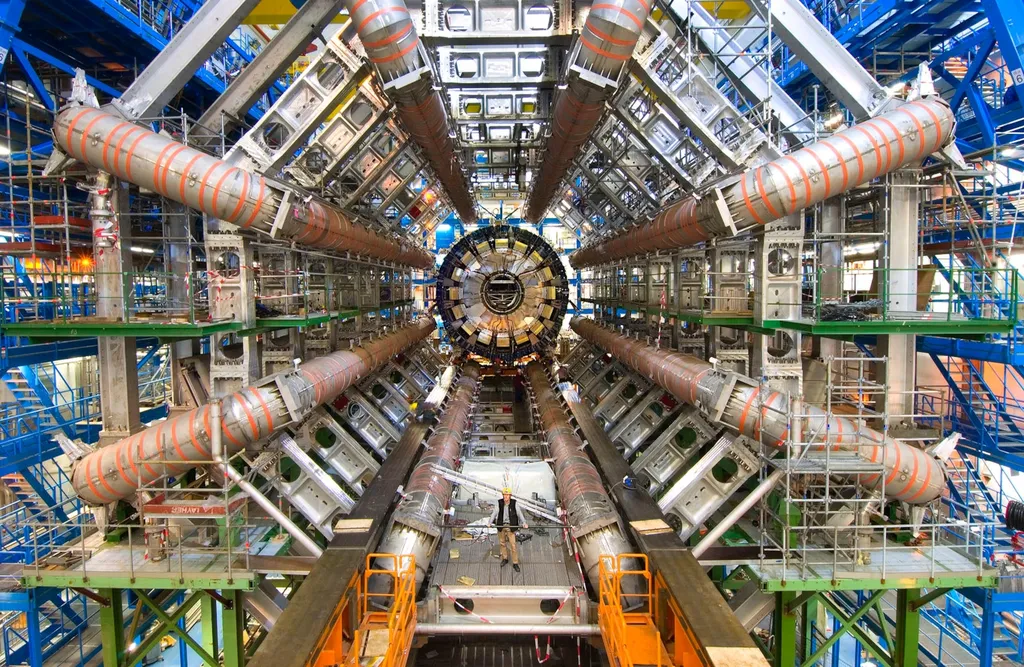
In the realm of high-energy physics, a team of researchers from CERN, including Andrea Coccaro, Francesco Armando Di Bello, Lucrezia Rambelli, Stefano Rosati, and Carlo Schiavi, has developed a novel approach to particle tracking that could have significant implications for data analysis and event reconstruction. Their work, published in the journal Nature Machine Intelligence, introduces a differentiable programming paradigm to improve the precision of tracking charged particles in collisions at the Large Hadron Collider (LHC).
The researchers’ new method focuses on enhancing the reconstruction of particle trajectories, a critical process for reliable event reconstruction and accurate physics analyses. By employing a machine learning model that incorporates physics priors, they have created an optimized pipeline that can simultaneously reconstruct tracks and determine their transverse momenta. This is achieved through a combination of a graph attention network and differentiable clustering and fitting routines.
The model is trained using a composite loss function, which, due to its differentiable design, allows physical constraints to be effectively back-propagated through both the neural network and the fitting procedures. This approach improves overall performance compared to more traditional, factorized methods. The enhanced precision in hit selection and transverse momentum estimation leads to better resolution of reconstructed physics observables and more efficient trigger threshold settings. These improvements enable more effective data selection within the given data acquisition constraints.
For the energy industry, the practical applications of this research are primarily indirect but noteworthy. The techniques developed for high-precision particle tracking can inspire similar advancements in data analysis and event reconstruction in other high-data environments. For instance, the energy sector often deals with vast amounts of data from sensors and monitoring systems. Applying machine learning models that incorporate domain-specific knowledge, similar to the physics priors used in this research, could lead to more accurate and efficient data analysis. This could improve predictive maintenance, optimize energy production, and enhance safety monitoring in energy facilities.
Moreover, the differentiable programming paradigm demonstrated in this research could be adapted to other complex systems where precise tracking and reconstruction of events are crucial. For example, in smart grid management, tracking the flow of energy and identifying anomalies could benefit from similar machine learning approaches. By integrating domain-specific knowledge into machine learning models, energy companies could achieve more accurate and reliable predictions, leading to better decision-making and operational efficiency.
In summary, while the research is primarily focused on high-energy physics, its innovative approach to machine learning and data analysis has the potential to inspire similar advancements in the energy sector. By leveraging domain-specific knowledge and differentiable programming, energy companies could enhance their data analysis capabilities, leading to improved operational efficiency and safety.
This article is based on research available at arXiv.