
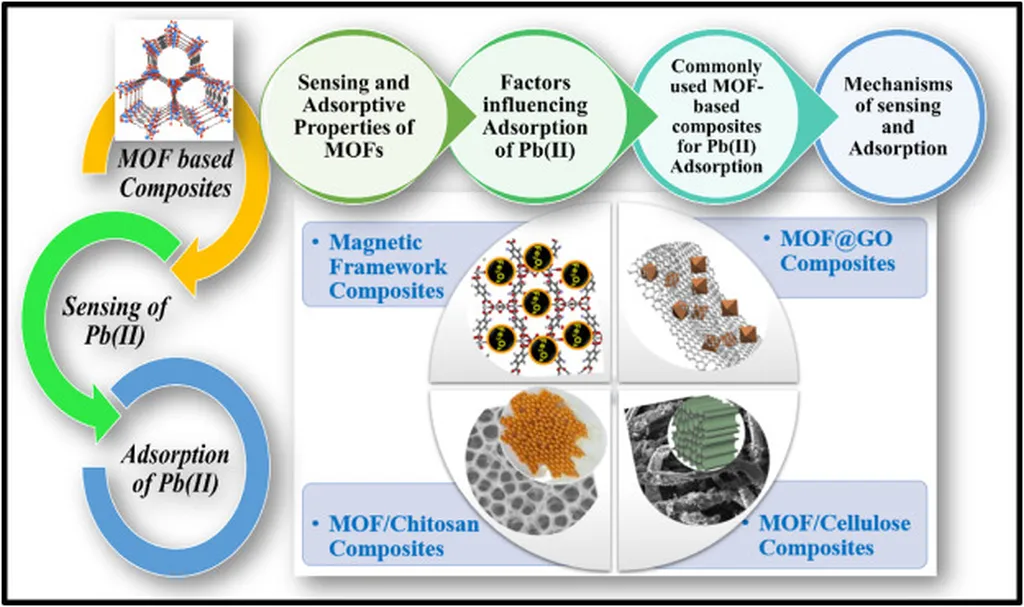
In the realm of energy materials, a team of researchers from various institutions, including the University of California, Berkeley, and the University of Pavia, Italy, has been exploring the magnetic properties of a unique metal-organic framework (MOF). Their work, published in the journal Nature Communications, focuses on a chromium-based MOF that exhibits unusual magnetic behavior at relatively high temperatures, offering potential applications in the energy sector.
Metal-organic frameworks are highly tunable materials composed of metal ions connected by organic ligands. They can be designed to exhibit magnetic properties, which could be useful for applications such as magnetic gas separation or lightweight, rare-earth-free permanent magnets. However, the magnetic ordering temperatures of these materials are typically very low, limiting their practical use.
The researchers studied a specific chromium-based MOF, Cr(tri)2(CF3SO3)0.33, which stands out due to its robust ferromagnetic behavior near ambient conditions. Using various techniques like magnetometry, nuclear magnetic resonance, and ferromagnetic resonance, they investigated the magnetic state of this material. They found that within the paramagnetic phase, the material develops mesoscopic magnetic correlated clusters. These clusters exhibit slow dynamics in the MHz range, which are tracked by the nuclear moments, indicating an unconventional magnetic transition.
The researchers also highlighted several thermally-activated relaxation mechanisms for the nuclear magnetization. These mechanisms are linked to the tendency of electrons to localize at low temperatures and the rotational dynamics of the charge-balancing triflate ions confined within the pores of the MOF.
The observed clustered phase in the paramagnetic regime is reminiscent of the magnetoelectronic phase segregation leading to colossal magnetoresistance in manganites and cobaltites. This finding suggests that high-temperature magnetic MOFs can serve as a versatile platform for exploring correlated electron phenomena in low-density, chemically tunable materials.
For the energy industry, these findings could pave the way for the development of novel magnetic materials that operate at higher temperatures and are free from rare-earth elements, which are often expensive and have supply chain issues. Potential applications include more efficient magnetic refrigeration systems, lightweight magnetic components for energy generation and storage, and advanced magnetic gas separation technologies. However, further research and development are needed to translate these fundamental findings into practical energy solutions.
The research was published in Nature Communications, a highly respected peer-reviewed journal. The open-access article can be found at the following DOI: 10.1038/s41467-023-36332-3.
This article is based on research available at arXiv.