
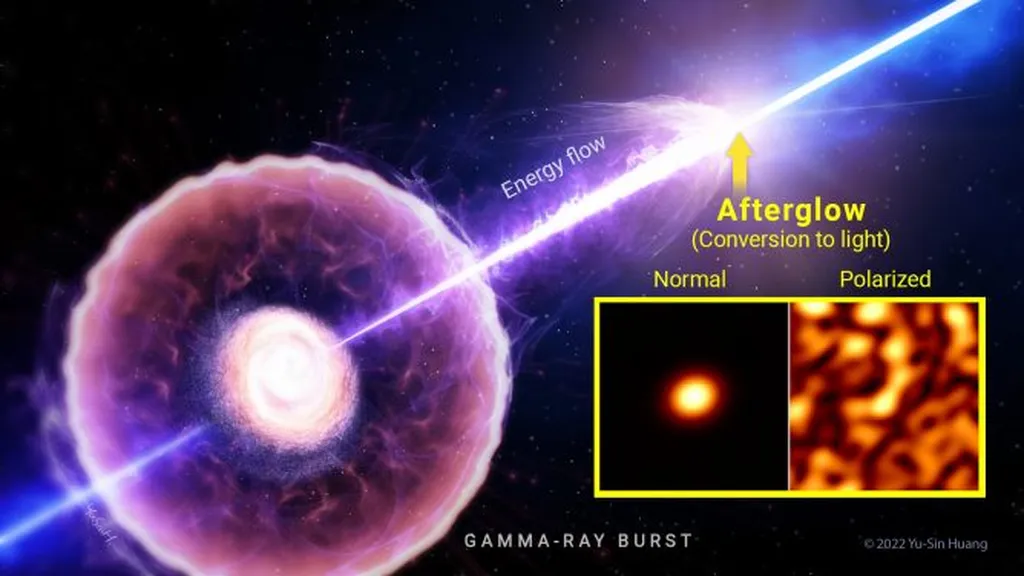
Researchers Edilberto Aguilar-Ruiz, Ramandeep Gill, Paz Beniamini, and Jonathan Granot, affiliated with institutions including the University of Maryland and the Florida State University, have recently published a study that advances our understanding of gamma-ray bursts (GRBs) and their afterglows. Their work, titled “Synchrotron Self-Compton Model of TeV Afterglows in Gamma-Ray Bursts,” was published in the Astrophysical Journal.
Gamma-ray bursts are among the most energetic events in the universe, releasing vast amounts of energy in the form of gamma rays. The afterglow emission that follows these bursts is well understood as synchrotron radiation, produced by electrons accelerated by the shock wave generated by the burst. However, the detection of a very-high-energy TeV spectral component in these afterglows has opened new avenues for exploring the energetics of these ultra-relativistic blast waves and the environments in which they propagate.
The researchers have developed a semi-analytic framework to model the synchrotron self-Compton (SSC) TeV emission. This emission occurs when the same distribution of electrons that produce the synchrotron radiation also inverse-Compton upscatters the softer synchrotron photons to higher energies. Previous models often required computationally expensive numerical treatments, making them impractical for fitting to observations using Markov Chain Monte Carlo (MCMC) methods. The new model accounts for various physical effects, including adiabatic cooling and expansion, photon escape, and Klein-Nishina effects, providing a more accurate and efficient tool for analyzing GRB afterglows.
The researchers applied their model to the afterglow observations of the TeV bright GRB 190114C. They found that the data is best explained by an energetic blast wave propagating inside a radially stratified external medium with a number density that decreases with distance more slowly than expected for a steady wind from the progenitor star. This suggests a non-steady wind or a transition to an interstellar medium.
The practical applications of this research for the energy sector are indirect but significant. Understanding the physics of GRBs and their afterglows can contribute to our broader knowledge of high-energy astrophysical processes, which can inform the development of advanced energy technologies. For instance, insights into particle acceleration mechanisms in astrophysical shocks can inspire innovations in plasma physics and laser-driven particle acceleration, which have potential applications in energy production and medical imaging. Additionally, the computational methods developed for analyzing GRB data can be adapted for use in other areas of energy research that require sophisticated data analysis and modeling.
In summary, the researchers have made significant strides in modeling the TeV afterglows of gamma-ray bursts, providing a powerful tool for interpreting observational data and gaining insights into the physics of these extreme astrophysical events. Their work not only advances our understanding of the universe but also has the potential to inspire innovations in the energy sector.
This article is based on research available at arXiv.