
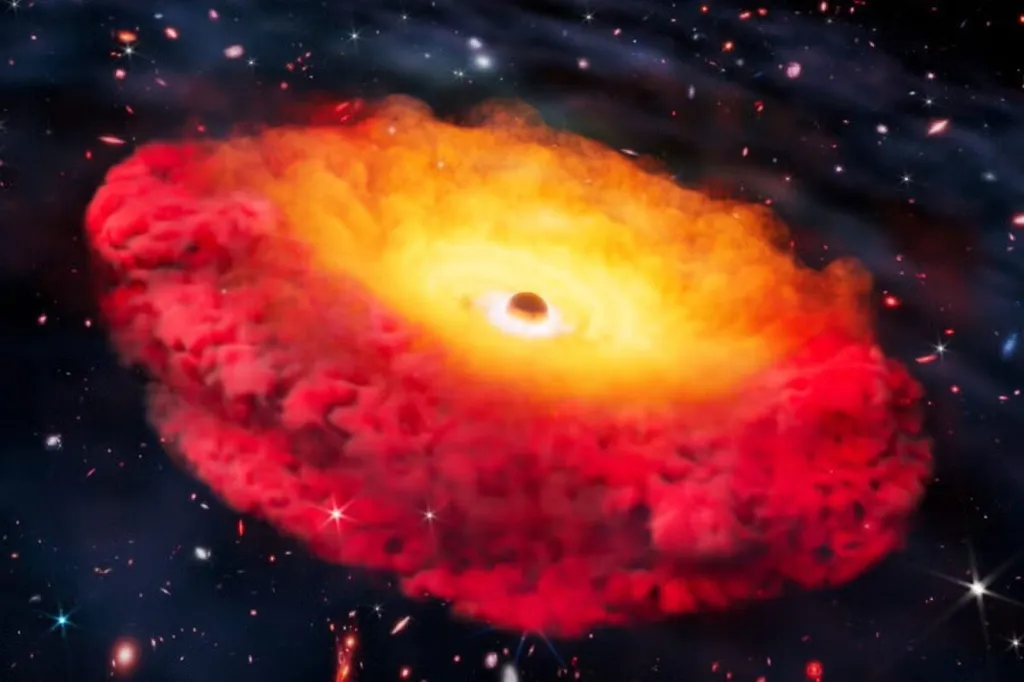
In a groundbreaking study, an international team of researchers led by Anna de Graaff from the University of Edinburgh has unveiled new insights into the nature of “little red dots” (LRDs) in the universe. These LRDs, observed using the James Webb Space Telescope (JWST), are now understood to be active galactic nuclei (AGN) embedded in dense, thermalized gas envelopes. The team’s findings, published in the journal Nature Astronomy, have significant implications for our understanding of the early universe and the evolution of galaxies.
The researchers utilized the DAWN JWST Archive to construct and characterize a sample of 116 LRDs across a range of redshifts (2.3 < z < 9.3). They selected sources with V-shaped UV-optical continua from NIRSpec/PRISM spectra and compact morphologies in NIRCam/F444W imaging. The study revealed that the continuum spectra of LRDs are ubiquitously well described by modified blackbodies across the 0.4-1.0μm range, with typical temperatures around 5000K or peak wavelengths around 0.65μm. This indicates that LRDs trace a locus in the Hertzsprung-Russell diagram analogous to stars on the Hayashi track, supporting the idea that LRDs are AGN embedded in thermalized dense gas envelopes in approximate hydrostatic equilibrium. The researchers found that hotter LRDs with peak wavelengths shorter than 0.65μm typically exhibit strong Balmer breaks, redder UV slopes, and high optical luminosities. Other LRDs show weak or no Balmer breaks and a wide variety in UV slopes and optical luminosities. Crucially, the study demonstrated that the UV-optical continuum shapes and luminosities are strongly linked to the Hα, Hβ, [OIII], and OI line properties. There is a tight linear relation between the Hα and optical continuum luminosities, as well as Hα and OI8446, indicating that Balmer, OI, and optical emission must primarily be powered by the same source. The Balmer decrement increases strongly toward higher Hα luminosities, optical continuum luminosities, and Balmer break strength, providing key evidence for luminosity-dependent effects of collisional (de-)excitation and resonant scattering in the gaseous envelopes. In contrast, the study showed that [OIII] emission likely originates from star-forming host galaxies, and its strong correlation with Balmer break strength arises naturally from variation in the AGN-to-host ratio. This research presents an empirical description of the nature and structure of LRDs, defining a new benchmark for ongoing LRD model developments. The findings have practical applications for the energy sector, particularly in understanding the evolution of galaxies and the role of AGN in galaxy formation and evolution. This knowledge can inform models of galaxy evolution and the intergalactic medium, which are crucial for understanding the large-scale structure of the universe and the distribution of dark matter and dark energy. Additionally, the study's insights into the nature of AGN can help in the development of more accurate models of black hole growth and feedback, which are essential for understanding the co-evolution of supermassive black holes and their host galaxies. Source: Nature Astronomy This article is based on research available at arXiv.