
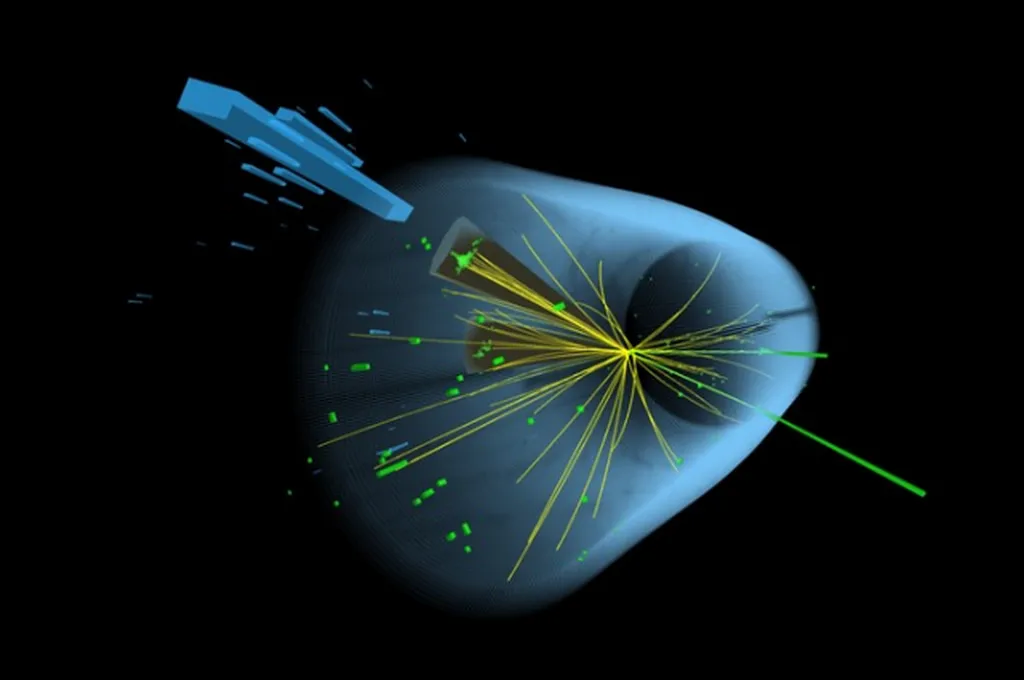
In the realm of particle physics, a trio of researchers from the University of Zurich—Ilaria Brivio, Ramona Gröber, and Konstantin Schmid—have delved into the complexities of Higgs boson pair production, a process that could offer valuable insights into the fundamental theories governing particle interactions. Their work, published in the Journal of High Energy Physics, focuses on the Higgs Effective Field Theory (HEFT) framework and its implications for understanding the behavior of Higgs bosons.
The researchers’ study centers on the production of Higgs boson pairs through a process known as gluon fusion. This phenomenon is particularly intriguing because it allows scientists to examine the relationships between the Higgs boson’s couplings to other particles, such as fermions and gauge bosons. Within the Standard Model Effective Field Theory (SMEFT), these couplings remain interconnected at a specific level of complexity, known as dimension six. However, in HEFT, these couplings can become entirely independent of each other even at the most basic level of the theory’s expansion.
The team’s investigation reveals that to maintain a consistent theoretical approach—termed power counting—and to incorporate next-to-leading order diagrams, it is essential to consider higher-dimensional operators beyond the most basic ones. These additional operators have significant phenomenological impacts, meaning they influence the observable outcomes of the theoretical models. The researchers critically re-evaluate commonly used kinematic benchmark scenarios in experimental searches for non-resonant di-Higgs production, taking into account these extra contributions.
The practical applications of this research for the energy sector are not immediate, as the study is fundamentally theoretical and focused on particle physics. However, understanding the underlying principles of particle interactions and the behavior of fundamental particles like the Higgs boson can have broader implications for advanced energy technologies, particularly those that might harness fundamental forces and particles in novel ways. For now, the work serves as a critical step in refining our theoretical models and improving our ability to probe the deepest mysteries of the universe.
This article is based on research available at arXiv.