
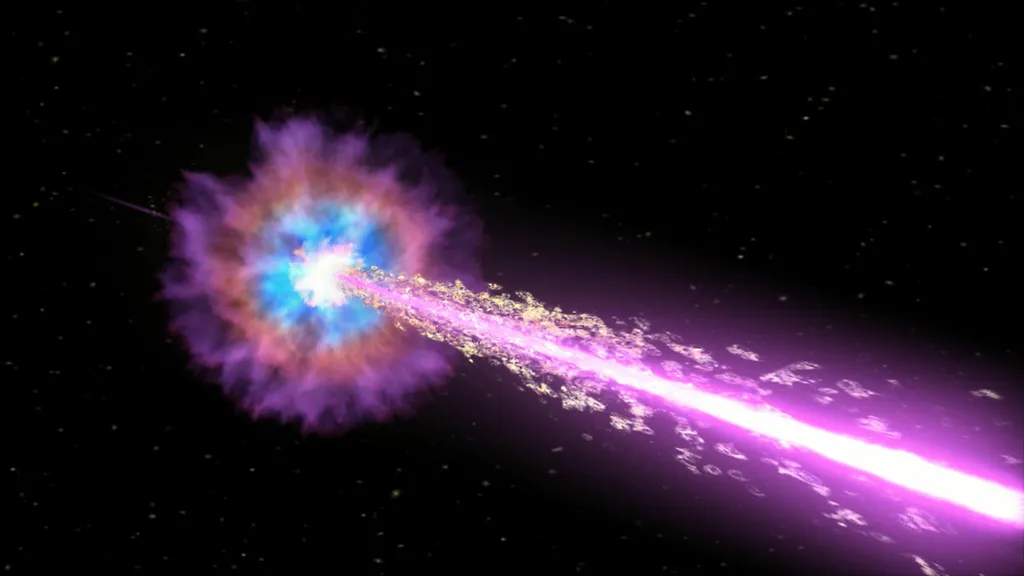
In the realm of astrophysics and energy distribution studies, a team of researchers from various institutions, including Nissim Fraija from the Universidad de Guadalajara, Boris Betancourt-Kamenetskaia from the Universidad de Costa Rica, Antonio Galván from the Universidad de Granada, and Maria Dainotti from the National Astronomical Observatory of Japan, have delved into the intriguing phenomena of gamma-ray bursts (GRBs). Their work, published in the Astrophysical Journal, explores the dynamic behavior of microphysical parameters during relativistic shocks, offering insights that could have implications for understanding energy distribution in extreme astrophysical environments.
Gamma-ray bursts are among the most energetic events in the universe, releasing vast amounts of energy in the form of gamma rays. These bursts are thought to originate from the collapse of massive stars or the merging of compact objects, and they provide a unique laboratory for studying the physics of relativistic shocks and particle acceleration. In their study, the researchers focused on the synchrotron-self Compton (SSC) process, which involves the scattering of low-energy photons by high-energy electrons, leading to the emission of higher-energy photons. This process is influenced by microphysical parameters, such as the fraction of energy transferred to particles and magnetic fields, which are typically assumed to be constant but may actually vary over time.
The researchers derived light curves and closure relations for the SSC process in the context of the external reverse shock (RS), considering both homogeneous and stellar-wind environments. They examined the evolution of the RS in different regimes and demonstrated that variations in microphysical parameters can lead to observable features in the light curves, such as plateau phases and steeper temporal decay indices. These findings suggest that the dynamic behavior of microphysical parameters can significantly impact the observed properties of GRBs, providing a new lens through which to interpret these enigmatic events.
To validate their model, the researchers applied it to the spectral and temporal indices of GRBs reported in the Second Fermi-LAT Gamma-ray Burst Catalog (2FLGC) and bursts detected at very high energies. Using Markov Chain Monte Carlo (MCMC) simulations, they were able to constrain the microphysical parameters and gain insights into the underlying physics of these extreme astrophysical phenomena. While the direct practical applications for the energy sector may be limited, the study contributes to our fundamental understanding of energy distribution and particle acceleration in relativistic shocks, which could have broader implications for plasma physics and astrophysics.
This article is based on research available at arXiv.