
Researchers Donny Dwiputra, Ahmad R. T. Nugraha, Sasfan A. Wella, and Freddy Permana Zen from the Institute of Technology Bandung in Indonesia have published a study in Physical Review Letters that explores a novel approach to enhancing the performance of quantum batteries, which could have significant implications for energy storage technologies.
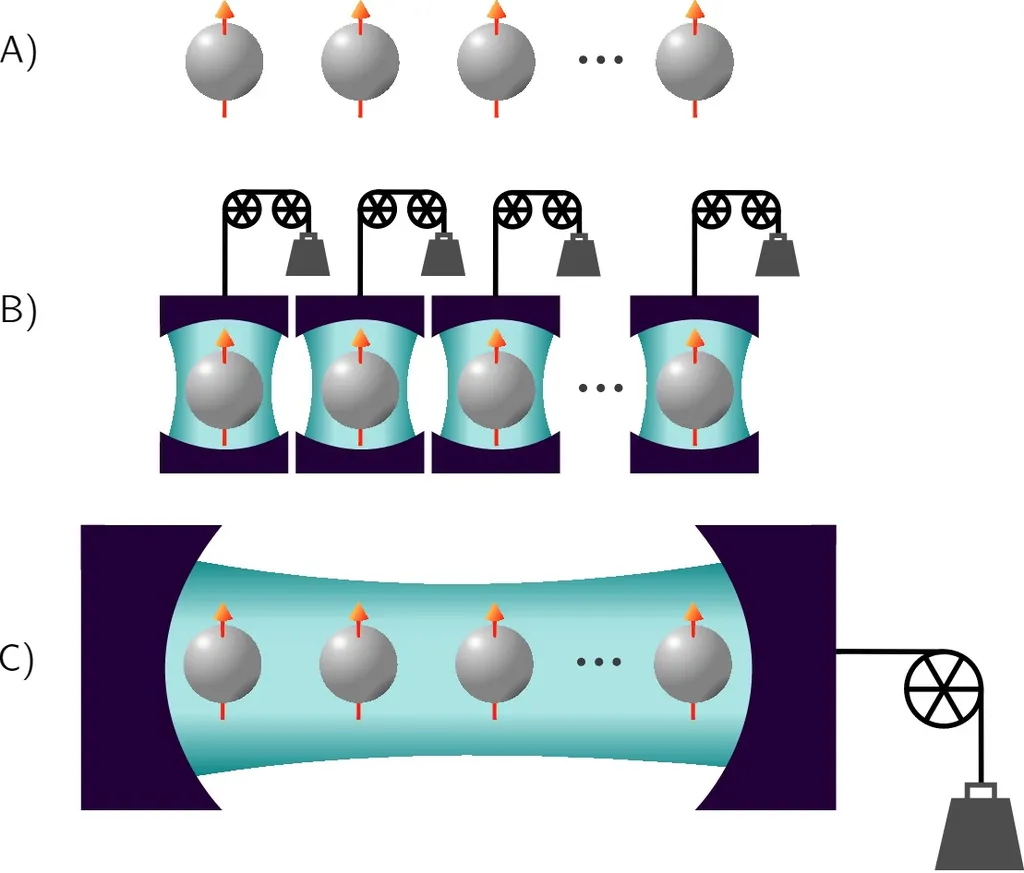
Quantum batteries leverage the principles of quantum mechanics to store and release energy. In this study, the researchers focused on bosonic modes, which are quantum systems with an unbounded energy spectrum, making them promising candidates for quantum batteries. However, a challenge in using these systems is that during the charging process, coherent oscillations occur between the charger and the battery, limiting the amount of energy that can be stored.
The researchers discovered that by introducing a slow quench—a gradual change—in the interaction between the charger and a coherently driven quadratic oscillator battery, the maximum power of the battery scales algebraically with the quench duration. This means that as the quench duration increases, the maximum power of the battery also increases, following a specific mathematical relationship. Counterintuitively, this implies that slower quenches lead to faster charging.
This finding is significant because it suggests a way to suppress the coherent energy oscillations that limit the energy storage capacity of quantum batteries. By slowing down the interaction between the charger and the battery, the researchers were able to achieve an unbounded increase in power. This could potentially lead to more efficient and powerful energy storage solutions.
However, the researchers also noted that charger dissipation—a loss of energy due to interactions with the environment—imposes a finite limit on the maximum power that can be achieved. This means that while the algebraic scaling of power with quench duration is a promising result, practical applications will still be subject to the constraints of real-world conditions.
The study also demonstrated that the temporal extensive scaling observed in the quadratic oscillator battery is not unique to this system. By mapping the system to a coherently driven Tavis-Cummings battery, the researchers showed that the same principles apply more broadly, suggesting that the findings could be relevant to a wide range of quantum battery systems.
In summary, this research provides a new approach to enhancing the performance of quantum batteries by leveraging slow quenches to suppress coherent energy oscillations. While practical applications will need to consider the effects of dissipation, the findings offer a promising avenue for developing more efficient energy storage technologies. The research was published in Physical Review Letters, a prestigious journal in the field of physics.
This article is based on research available at arXiv.