
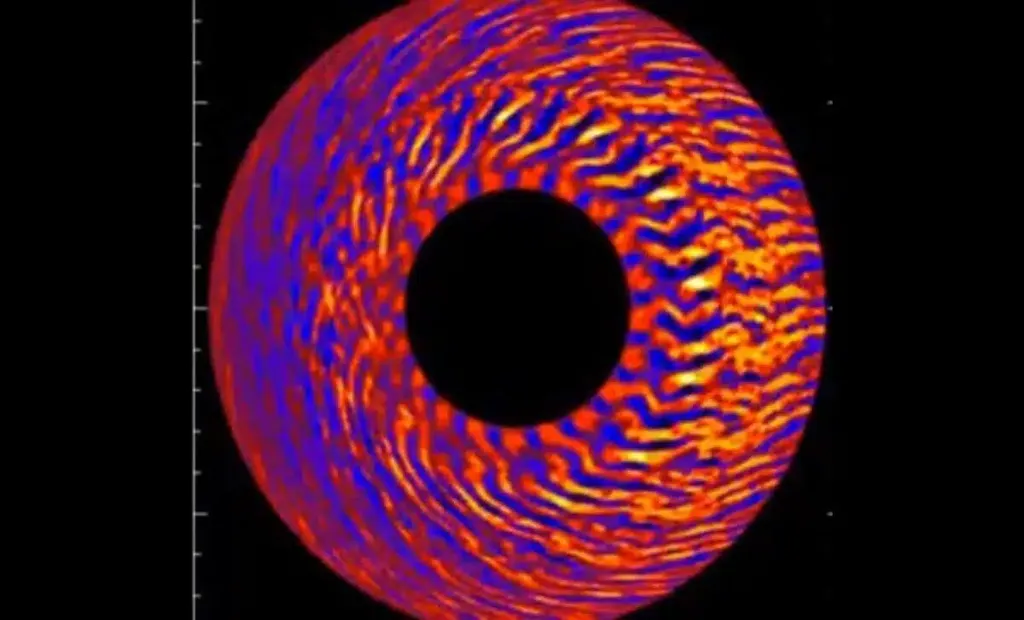
Rostislav-Paul Wilhelm and Fabio Bacchini, researchers at the University of Vienna and the University of Innsbruck respectively, have developed a new method for simulating the behavior of plasmas, which are hot, charged gases that make up over 99% of the visible universe. Their work, published in the Journal of Computational Physics, focuses on improving the accuracy and efficiency of plasma simulations, which are crucial for understanding and advancing technologies in the energy sector, such as fusion energy and space weather prediction.
Plasmas are often modeled using fluid equations, but these models can break down in certain regimes, such as in the solar wind or in fusion devices, where the plasma is not in thermal equilibrium and collisions between particles are rare. In these cases, the Vlasov-Maxwell system, which describes the evolution of the distribution function of each species of particle in phase space (position and velocity) coupled to the electromagnetic fields, is the most accurate model. However, simulating this system is extremely challenging due to its high dimensionality, strong filamentation, and multi-scale structure.
The standard method for simulating the Vlasov-Maxwell system is Particle-In-Cell (PIC), which represents the plasma as a collection of macro-particles and solves for their trajectories and the electromagnetic fields. However, PIC methods have limitations, particularly when it comes to accurately simulating the behavior of electrons, which are much lighter and faster than ions. The memory cost and intrinsic noise of PIC methods can hinder accurate electron-scale simulations.
To overcome these challenges, Wilhelm and Bacchini have developed a new method based on an iterative-in-time approximation of characteristics. This approach reconstructs the phase-space dynamics from the time history of the electromagnetic fields and the initial distribution functions. By doing so, it enables extremely high effective resolution far below the phase-space grid scale without storing or advecting high-dimensional data. This method was previously demonstrated for the multi-species electrostatic Vlasov system, and in this work, the researchers extend it to the full Vlasov-Maxwell equations using a Hamiltonian splitting to advance the solution in a structure-preserving way while retaining the reduced memory footprint.
The practical applications of this research for the energy sector are significant. Accurate plasma simulations are crucial for the development of fusion energy, which promises a nearly limitless source of clean energy. They are also important for understanding and predicting space weather, which can have significant impacts on satellites, power grids, and other critical infrastructure. By improving the accuracy and efficiency of plasma simulations, this research could help accelerate the development of these technologies and improve our ability to predict and mitigate the impacts of space weather.
Source: Wilhelm, R.-P., & Bacchini, F. (2023). High fidelity simulations of the multi-species Vlasov-Maxwell system with the Numerical Flow Iteration. Journal of Computational Physics, 111860.
This article is based on research available at arXiv.