
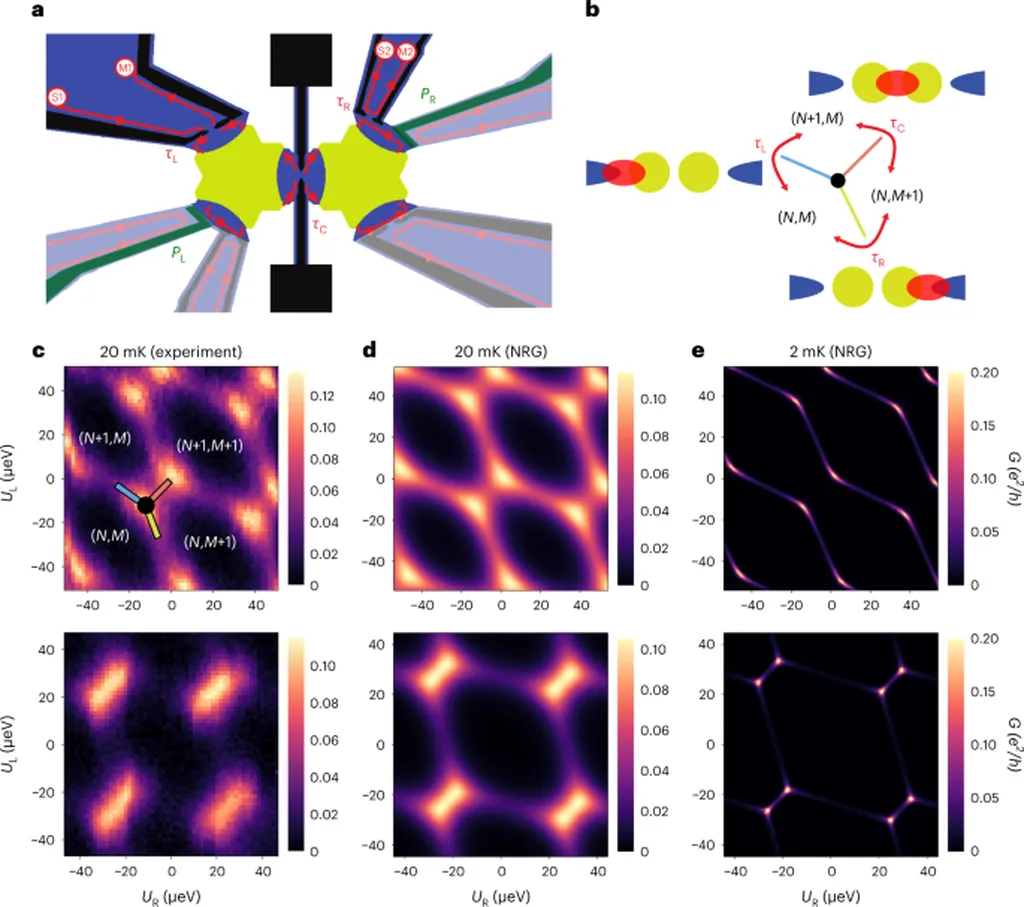
Researchers Zhanyu Ma, Cheolhee Han, F. Pierre, and Eran Sela, affiliated with the University of British Columbia and the University of California, Santa Barbara, have recently published a study in the journal Physical Review Letters. Their work focuses on a specific type of quantum circuit, known as a Charge Kondo circuit, and its potential applications in understanding and manipulating quantum systems.
Charge Kondo circuits consist of tiny metallic islands connected by quantum point contacts (QPCs), which are narrow constrictions that allow quantum particles to pass through one at a time. The charging energy of these islands makes the circuits highly tunable, enabling them to simulate various strongly interacting quantum models. In their study, the researchers propose a new circuit design that realizes the Kondo effect, a quantum phenomenon where a localized electron interacts with a sea of surrounding electrons, with effective Luttinger-liquid interactions. Luttinger liquids are a type of quantum fluid that exhibits unusual properties, such as spin-charge separation.
The researchers demonstrate that their circuit undergoes a localization transition, a phase change where the QPC transmission is fully suppressed below a critical value. This transition is characterized by a diverging charge susceptibility, which measures how the charge on the island responds to an external electric field, and an entropy step, a sudden change in the system’s entropy. These experimental signatures could be used to detect and study the localization transition in the lab.
The practical applications of this research for the energy sector are not immediate, as the study is primarily focused on fundamental quantum physics. However, a deeper understanding of quantum systems and their behavior could potentially lead to advances in quantum computing, sensing, and communication, which could have significant impacts on various industries, including energy. For instance, quantum sensors could be used to detect and monitor energy consumption in real-time, while quantum communication could enable secure and efficient energy trading. Moreover, the ability to simulate and control strongly interacting quantum models could help in the design of new materials for energy storage and conversion.
In summary, the researchers have proposed a new Charge Kondo circuit design that realizes the Kondo effect with effective Luttinger-liquid interactions and undergoes a localization transition. Their findings open a path toward realizing and studying localization transitions in more exotic settings, which could have potential applications in quantum technologies and beyond. The research was published in Physical Review Letters.
This article is based on research available at arXiv.