
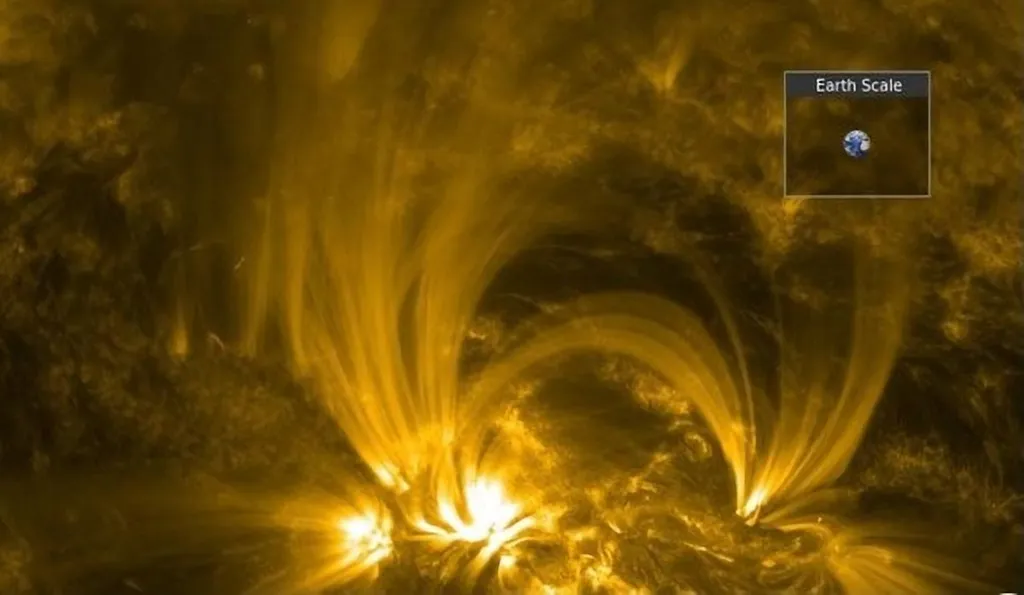
Researchers from the Leibniz Institute for Astrophysics Potsdam (AIP), including E. Mamonova, A. F. Kowalski, K. Herbst, S. Wedemeyer, and S. C. Werner, have developed a new model to better understand the impact of stellar flares on exoplanets orbiting young, active M dwarf stars. Their work, published in the journal Astronomy & Astrophysics, aims to improve our ability to characterize exoplanetary atmospheres by providing a more accurate representation of the energy deposited during flare events.
Stellar flares are sudden, intense bursts of energy from a star’s surface, which can significantly influence the atmospheres and habitability of orbiting exoplanets. Young M dwarf stars, in particular, are known for their frequent and powerful flares. To better understand these events and their impact on exoplanets, the researchers developed the Young M Dwarfs Flare (YMDF) model. This model combines radiative-hydrodynamic (RHD) stellar atmosphere models with high and low-energy electron beams to simulate the spectral and temporal evolution of flare events.
The YMDF model was validated using solar and stellar observations, and it successfully reproduced the observed continuum rise in both the TESS photometric band and the FUV-A spectral range. Additionally, the flare distributions generated by the model were consistent with those observed in a sample of young M dwarf stars. This consistency suggests that the YMDF model provides a physically motivated description of flare energetics and spectral features in the far-ultraviolet range.
For the energy sector, this research has implications for understanding the impact of stellar activity on the habitability of exoplanets, which could inform the search for life beyond our solar system. Additionally, the improved characterization of stellar flares can help refine models of exoplanetary atmospheres, which is crucial for assessing their potential for supporting life. While this research is primarily focused on astrophysics, the development of accurate models for understanding stellar activity can have broader applications in energy research, particularly in the study of plasma physics and the development of fusion energy technologies.
In summary, the YMDF model developed by researchers at the Leibniz Institute for Astrophysics Potsdam provides a valuable tool for studying the impact of stellar flares on exoplanets orbiting young, active M dwarf stars. By improving our understanding of flare energetics and spectral features, this model can help refine our characterization of exoplanetary atmospheres and inform the search for habitable worlds beyond our solar system.
This article is based on research available at arXiv.