
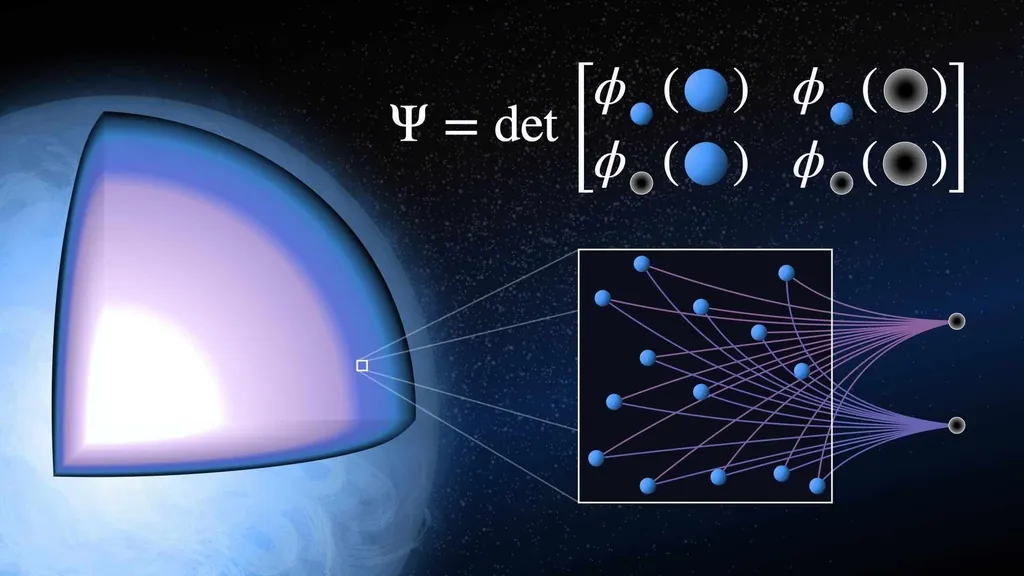
In the realm of astrophysics and energy research, a team of scientists from the University of Washington and the University of Pennsylvania have been delving into the intricate dynamics of neutron stars, particularly the behavior of superfluid vortices within their inner crusts. Their work, published in the journal Physical Review Letters, offers insights that could have implications for understanding the behavior of matter under extreme conditions, potentially influencing energy research and technology development.
Xin Sheng, Bennett Link, Matthew E. Caplan, and Yuri Levin have conducted three-dimensional simulations to study the interaction between superfluid vortices and the nuclear lattice in the inner crust of neutron stars. Their research focuses on the pinning and unpinning mechanisms of these vortices, which are influenced by various factors such as the nature of the nucleus-vortex interaction, lattice orientation, composition, temperature, and the energy of pinning to individual nuclei.
The team demonstrated that an initially moving vortex can be pinned to the lattice through the excitation of lattice vibrations. Interestingly, they found that this pinning process is more efficient when the nucleus-vortex interaction is attractive rather than repulsive. When a force is applied to unpin a vortex, the process is complex and influenced by multiple parameters. For instance, in lattices with multiple grains, the unpinning transition starts in grains with weaker pinning and propagates along the vortex, eventually crossing into grains with stronger pinning. This can lead to a decrease in the critical force required for unpinning and the creation of extended regions of unpinned vorticity.
The researchers also explored the effects of shearing the crust lattice, such as during a starquake. They found that this initiates the unpinning of vortices crossing the slip plane. Additionally, a close encounter between an unpinned vortex and a pinned vortex can cause the latter to unpin, potentially triggering an unpinning avalanche of many vortices.
While this research is primarily focused on astrophysical phenomena, understanding the behavior of matter under extreme conditions can have practical applications in the energy sector. For example, insights into the dynamics of superfluid vortices and their interactions with nuclear lattices could inform the development of advanced materials and technologies for energy storage and conversion, particularly in environments where extreme conditions are prevalent. The findings could also contribute to the broader understanding of fluid dynamics and material science, which are crucial for various energy technologies.
Source: Physical Review Letters
This article is based on research available at arXiv.