
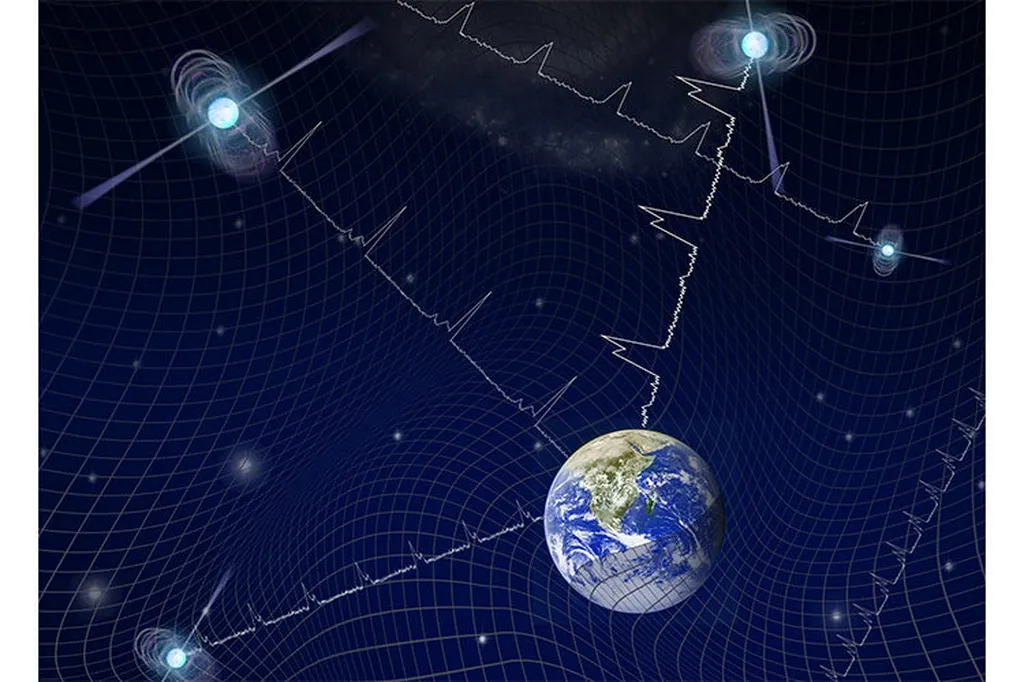
In the realm of energy research, a team of scientists from the North American Nanohertz Observatory for Gravitational Waves (NANOGrav) collaboration has made strides in improving the sensitivity and accuracy of pulsar timing arrays (PTAs), which could have implications for understanding and mitigating certain types of noise in energy systems. The researchers, led by Jeffrey S. Hazboun and including members from various institutions such as the University of British Columbia, the University of Texas at Austin, and the National Radio Astronomy Observatory, have published their findings in the Astrophysical Journal.
Pulsar timing arrays are used to detect gravitational waves, which are ripples in spacetime caused by massive, accelerating objects. These arrays rely on the precise timing of pulsars, which are rapidly spinning neutron stars that emit beams of electromagnetic radiation. The researchers have developed a new method for modeling and mitigating chromatic noise, which is noise that is dependent on the radio frequency used to observe the pulsars. This type of noise can be caused by various factors, including the solar wind and the interstellar medium.
The researchers tested a new class of models for PTA data, based on Gaussian processes in the time domain. These models use the covariance matrix to describe the statistics of the chromatic processes, and can be effectively equivalent to Fourier-domain models in mitigating chromatic noise. The researchers also presented a method for Bayesian model selection across the various choices of kernel, as well as deterministic chromatic models for non-stationary chromatic events and the solar wind.
As PTAs turn towards high frequency sensitivity, the size of the basis used to model these processes will need to increase, and these time-domain models present some computational efficiencies compared to Fourier-domain models. The researchers suggest that these models could be useful for improving the sensitivity and accuracy of PTAs, which could have implications for understanding and mitigating certain types of noise in energy systems.
For example, the techniques developed for modeling and mitigating chromatic noise in PTAs could be applied to improve the performance of radio frequency communication systems used in the energy sector. These systems are vulnerable to interference and noise, which can degrade their performance and reliability. By using the methods developed by the NANOGrav collaboration, it may be possible to better understand and mitigate the sources of noise in these systems, leading to more efficient and reliable communication.
In conclusion, the research published in the Astrophysical Journal by the NANOGrav collaboration presents a new method for modeling and mitigating chromatic noise in pulsar timing arrays. This research could have practical applications for improving the performance of radio frequency communication systems used in the energy sector, leading to more efficient and reliable communication.
This article is based on research available at arXiv.