
Researchers from the Moscow Institute of Physics and Technology, including Mikhail Sergeev, Georgii Paradezhenko, Daniil Rabinovich, and Vladimir V. Palyulin, have developed a novel approach to quantum architecture search (QAS) using multi-agent reinforcement learning. Their work aims to improve the scalability and efficiency of designing quantum circuits for variational quantum algorithms, which are crucial for quantum computing applications in the energy sector and beyond.
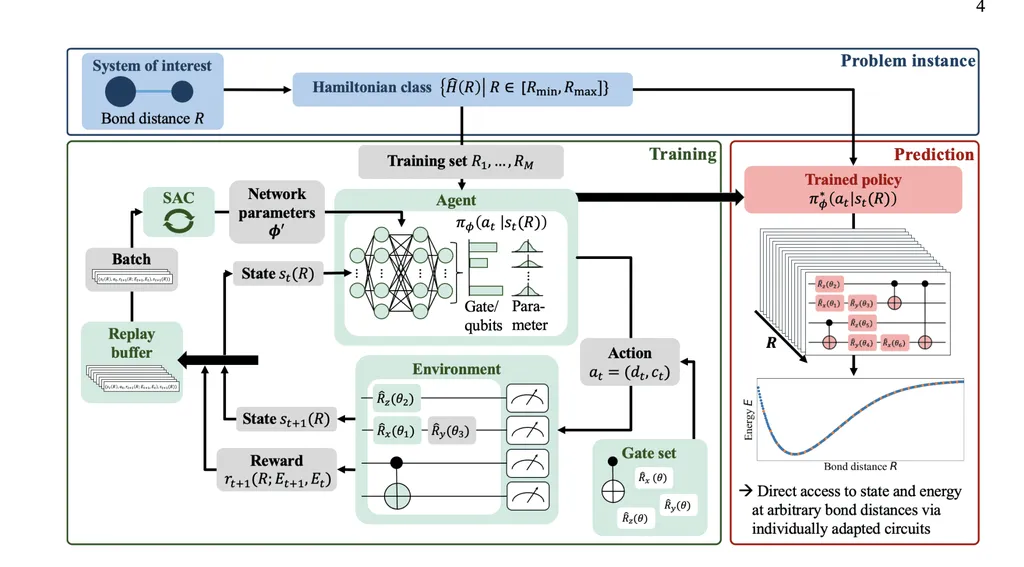
Quantum architecture search automates the design of parameterized quantum circuits, finding the most suitable structure for a given problem. Reinforcement learning (RL) has shown promise in this area, but current single-agent RL approaches struggle with scalability as the number of qubits increases. The researchers propose a multi-agent RL algorithm where each agent operates on its own block of a quantum circuit. This approach significantly accelerates the convergence of RL-based QAS and reduces computational costs.
The team benchmarked their algorithm on two problems: the MaxCut problem on 3-regular graphs and ground energy estimation for the Schwinger Hamiltonian. The multi-agent approach demonstrated improved performance and efficiency compared to single-agent methods. Additionally, the distributed nature of the multi-agent system aligns well with modern intermediate-scale quantum devices, making it practical for current and near-future quantum hardware.
This research, published in the journal Quantum Machine Intelligence, highlights the potential of multi-agent reinforcement learning to enhance the design of quantum circuits. For the energy sector, this could lead to more efficient quantum algorithms for optimizing complex systems, such as power grids and energy distribution networks. As quantum computing technology advances, these methods could play a crucial role in developing scalable and efficient quantum solutions for energy-related challenges.
The researchers’ work underscores the importance of innovative approaches in quantum computing, paving the way for more practical and scalable applications in various industries, including energy. By improving the efficiency of quantum architecture search, they bring us closer to realizing the full potential of quantum computing in solving real-world problems.
This article is based on research available at arXiv.