
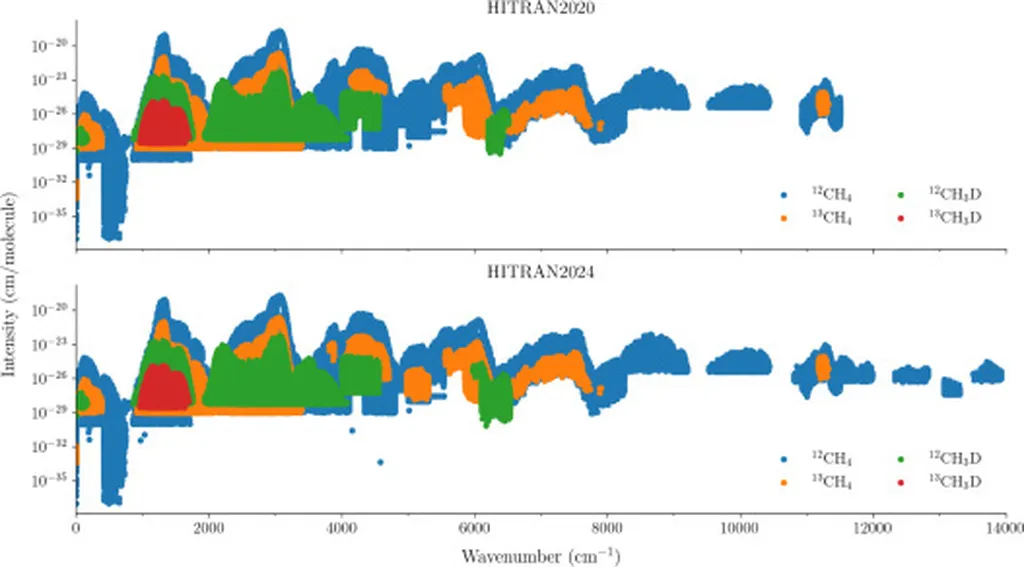
In the realm of energy and environmental science, a team of researchers from various institutions, including the Laboratoire Interuniversitaire des Systèmes Atmosphériques, the University of Cambridge, the University of Reims Champagne-Ardenne, the University of Maryland, the Jet Propulsion Laboratory, and the University of Colorado Boulder, has recently updated the HITRAN database to improve the spectroscopic parameters of methane. This update, known as HITRAN2024, is a significant step forward in the accurate detection and measurement of methane, a potent greenhouse gas.
The HITRAN database is a critical tool used in the energy sector for remote sensing and monitoring of greenhouse gases. Methane, in particular, is a key focus due to its significant contribution to global warming. The recent update involves the replacement of about 60,000 lines of the four most abundant isotopologues of methane, covering a wide range of spectral regions from the dyad to the triacontad. This update includes 56,000 transition wavenumbers, 16,000 line intensities, 30,000 pressure-broadening half-widths, and 3500 assignments. Additionally, 40,000 new lines have been added, extending the database from 12,000 cm^-1 up to 14,000 cm^-1 and filling in some gaps.
The researchers placed a greater emphasis on the pentad, octad, and tetradecad regions, which are targeted by several remote instruments. In these regions, comparisons of spectral fits from multiple line lists were performed, and only the parameters that provided the best fit for each line were retained. In the ν3 band, the researchers used gathered speed-independent pressure broadenings of 12CH4 to fit Pade-approximant functions. These functions replaced outdated experimental data in ν3, missing data in the new lines, and values that were determined to be outside their physical boundaries. The CH3D broadenings were replaced in a similar manner, using a semi-empirical formula for missing and low or high values.
The practical applications of this research for the energy sector are significant. Accurate spectroscopic parameters of methane are crucial for the development of remote sensing technologies used to monitor methane emissions from various sources, including oil and gas operations, landfills, and agriculture. Improved detection and measurement of methane can help energy companies identify and mitigate leaks, reduce emissions, and comply with regulatory requirements. Additionally, this research can support the development of new technologies for methane capture and utilization, contributing to a more sustainable energy future.
The research was published in the Journal of Quantitative Spectroscopy and Radiative Transfer, a leading journal in the field of spectroscopy and radiative transfer. The updated HITRAN2024 database is now available for use by researchers, industry professionals, and policymakers working to address the challenges of methane emissions and climate change.
This article is based on research available at arXiv.