
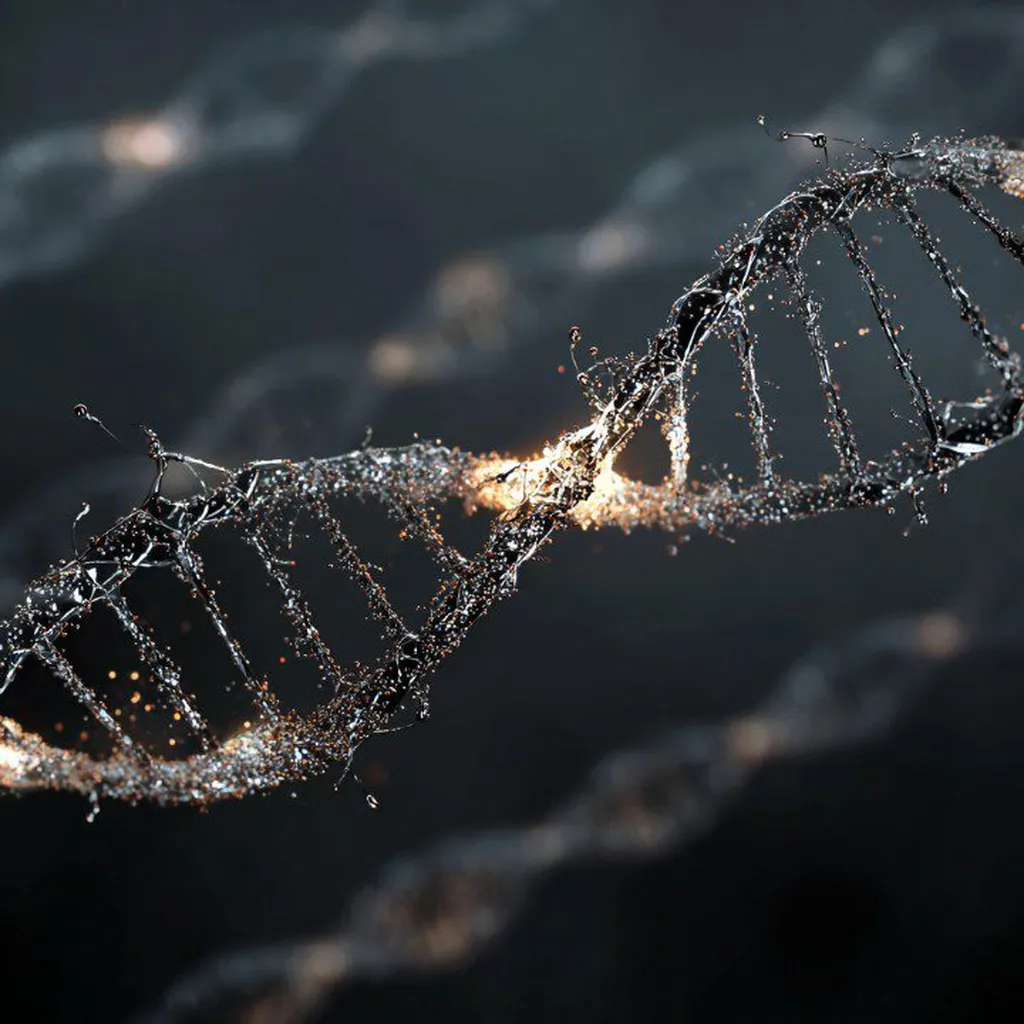
Researchers Raul Quintero-Monsebaiz, Per Hyldgaard, and Elsebeth Schröder from the University of California, San Diego, have delved into the intricate world of DNA’s photophysical properties, shedding light on how charges and free radicals interact with our genetic code. Their work, published in the Journal of Physics: Condensed Matter, focuses on understanding and potentially controlling the damage caused by these interactions, which could have significant implications for the energy sector, particularly in areas like radiation therapy and genetic damage mitigation.
The team’s research centers around quasi-particles (QPs), which are sudden optically-driven excitations that occur when DNA is exposed to light. These QPs can either charge a nucleobase and place an electron nearby, or trap a free electron and emit a low-energy photon. The behavior of these QPs can help us understand and predict the interactions between DNA and its environment, as well as the potential damage that might follow.
To analyze these QPs, the researchers utilized a recently developed computational method called AHBR-mRSH*. This method allowed them to study the electron-attached and ionized QP states of DNA components, with a particular focus on dipole- and multipole-trapped empty states. They also evaluated critical properties such as dipole and quadrupole moments, QP HOMO-LUMO energy gaps, and transition-dipole moments.
One of the key findings of this study is the classification of Watson-Crick stacked dimers based on their QP nature. This classification provides a foundation for proposing a model of DNA reactivity and photo-physical activity. Understanding these processes can help in developing strategies to mitigate genetic damage caused by radiation, which is particularly relevant in the energy sector where radiation exposure is a concern.
In practical terms, this research could lead to the development of new materials and technologies that are more resistant to radiation damage. It could also inform the design of more effective radiation therapies, which use radiation to target and kill cancer cells. By understanding how DNA interacts with radiation, we can develop more precise and effective treatments that minimize damage to healthy cells.
In conclusion, the work of Quintero-Monsebaiz, Hyldgaard, and Schröder provides valuable insights into the photophysical properties of DNA and the behavior of quasi-particles. Their findings have significant implications for the energy sector, particularly in areas like radiation therapy and genetic damage mitigation. As we continue to explore the complexities of DNA and its interactions, we open up new possibilities for innovation and discovery in the field of energy. (Source: Journal of Physics: Condensed Matter)
This article is based on research available at arXiv.