
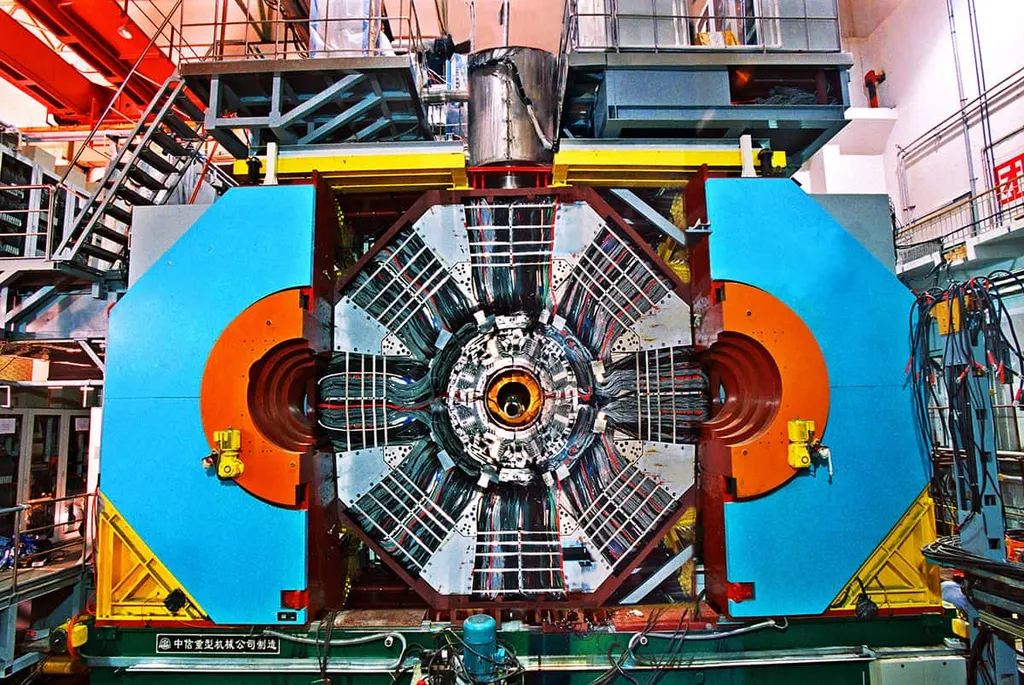
In the realm of particle and nuclear physics, a team of researchers led by Xurong Chen from the Institute of Modern Physics at the Chinese Academy of Sciences, along with colleagues from various institutions including the University of Science and Technology of China and the University of Chinese Academy of Sciences, is making significant strides. They are proposing a new experimental setup called the Huizhou Hadron Spectrometer (HHaS) at the High Intensity Heavy-ion Accelerator Facility (HIAF) in Huizhou, Guangdong Province, China. This facility, expected to be completed by 2025, will be a versatile platform for advanced fundamental physics research.
The High Intensity Heavy-ion Accelerator Facility (HIAF) is designed to produce proton and heavy-ion beams with energies reaching several GeV. The researchers propose the development of the Huizhou Hadron Spectrometer (HHaS) to facilitate investigations at this facility. HHaS is conceptualized to include a solenoid magnet, a five-dimensional silicon pixel tracker, a Low-Gain Avalanche Detector (LGAD) for time-of-flight measurements, and a Cherenkov-scintillation dual-readout electromagnetic calorimeter. This design aims to achieve an unprecedented event rate of 1-100 MHz, extensive particle acceptance, a track momentum resolution at the 1% level, an electromagnetic energy resolution of approximately 3% at 1 GeV, and multi-particle identification capabilities.
The primary scientific objectives of HHaS include exploring physics beyond the Standard Model by searching for novel particles and interactions, testing fundamental symmetries, investigating exotic hadronic states such as di-baryons and pentaquark states, conducting precise measurements of hadron and hypernucleus properties, and probing the phase boundary and critical point of nuclear matter. The successful realization of HHaS is expected to significantly advance medium- and high-energy physics research within China.
For the energy sector, the advancements in particle and nuclear physics facilitated by HHaS could have indirect implications. Understanding fundamental particles and their interactions can contribute to the development of advanced materials and technologies used in energy production, storage, and transmission. For instance, improvements in particle detection and measurement technologies can enhance the efficiency and safety of nuclear energy systems. Additionally, insights into exotic hadronic states and nuclear matter properties can inform the development of next-generation nuclear reactors and fusion energy technologies.
The research was published in the journal Nuclear Science and Techniques, providing a detailed conceptual design and scientific objectives of the Huizhou Hadron Spectrometer (HHaS). This initiative represents a significant step forward in the field of particle and nuclear physics, with potential benefits for the energy sector through the development of advanced technologies and materials.
This article is based on research available at arXiv.