
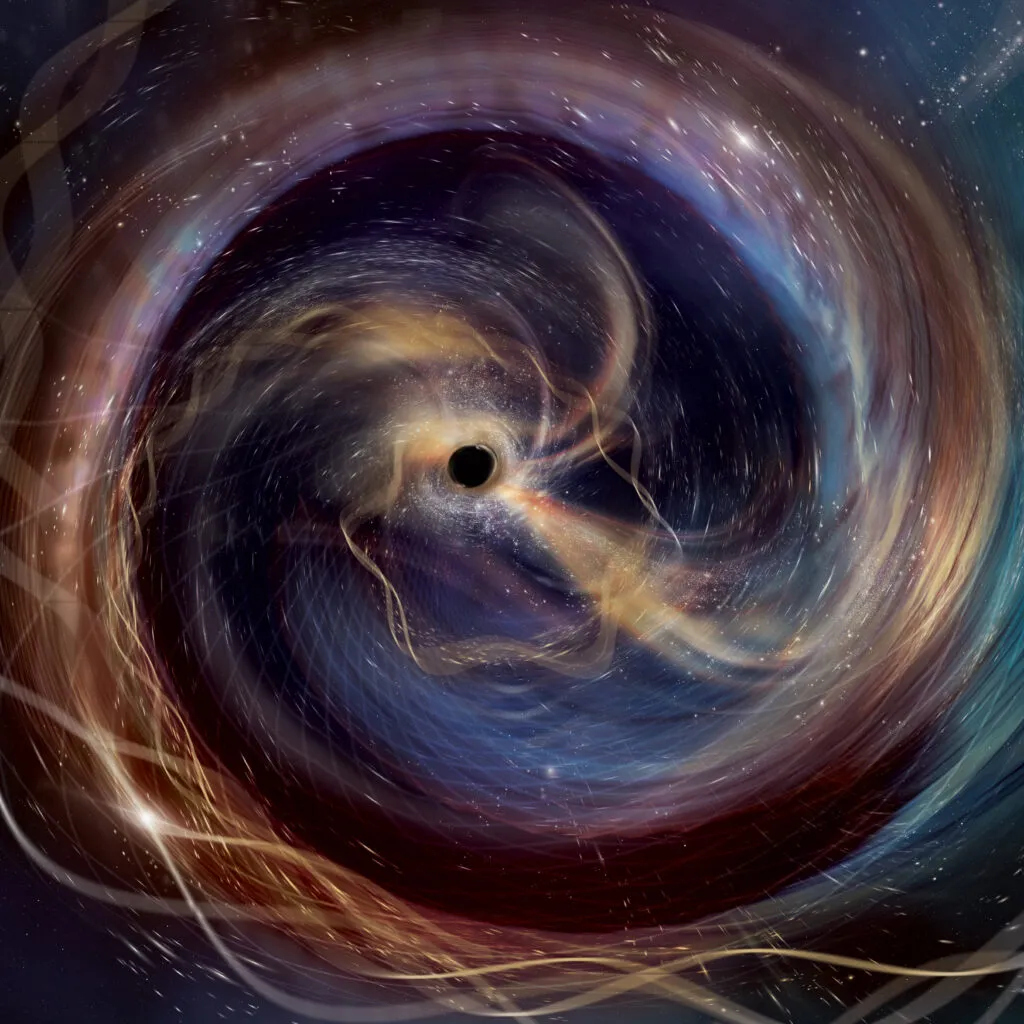
Researchers Dejan Gajic and Lionor Kehrberger, affiliated with the Max Planck Institute for Gravitational Physics in Germany, have recently published a study that delves into the behavior of waves in the vicinity of black holes. Their work, titled “Linear and nonlinear late-time tails on dynamical black hole spacetimes via time integrals,” was published in the journal Physical Review D.
The researchers focused on understanding the long-term behavior of waves, such as those produced by gravitational disturbances or other forms of energy, in the exterior regions of black holes that are dynamically settling down to a stable state. Specifically, they examined how these waves decay over time when the black hole’s background is not stationary but is instead evolving towards a Schwarzschild black hole—a non-rotating, uncharged black hole.
Gajic and Kehrberger found that for waves that are not spherically symmetric, the decay rate deviates from what is known as Price’s law, which describes the decay of waves around stationary black holes. Instead, they observed that the waves decay more slowly by an additional power of time. This slower decay is characterized by an inverse-polynomial decay in time, which the researchers refer to as “late-time tails.”
The researchers’ proof hinges on a novel approach that connects the emergence of these late-time tails to the conformal irregularity properties of the solutions’ time integrals in space. By treating the dynamical wave operator as a Schwarzschild wave operator with an inhomogeneous term, they were able to derive almost-sharp decay estimates and then extend these to global asymptotics. This was achieved by comparing the solution to a carefully chosen global tail function.
In addition to linear wave equations, the researchers applied their method to several examples of nonlinear wave equations, demonstrating the robustness of their approach. They also discussed the potential applicability of their findings to more general settings, such as dynamical spacetimes converging to sub-extremal Kerr spacetimes (rotating black holes) and higher-dimensional wave operators with even or odd spacetime dimensions.
For the energy sector, this research could have implications for understanding the behavior of energy waves, such as those produced by seismic activity or other disturbances, in the vicinity of black holes. This could be particularly relevant for energy exploration and extraction in space, as well as for the development of advanced energy technologies that might involve the manipulation of gravitational fields. Furthermore, the insights gained from this study could contribute to the broader understanding of wave propagation and energy dissipation in extreme environments, which could have practical applications in various energy-related fields.
This article is based on research available at arXiv.