
In the evolving energy landscape, integrating high levels of renewable energy and managing long-distance power transmission present unique challenges to grid stability. Researchers MST Rumi Akter, Anamitra Pal, and Rajasekhar Anguluri from the University of Minnesota have proposed a novel approach to address these issues, focusing on damping low-frequency oscillations that can threaten the stability of bulk power systems. Their work, published in the IEEE Transactions on Power Systems, introduces a state-derivative feedback (SDF) damping controller designed to enhance grid stability in power-electronics-rich environments.
Low-frequency oscillations are a persistent challenge in modern power systems, particularly those with high renewable penetration and extensive transmission lines. Traditional damping strategies often rely on power modulation through high voltage DC (HVDC) systems or energy storage solutions. However, these methods can be limited by fixed control architectures that fail to adequately dampen certain oscillatory modes. The SDF controller developed by Akter, Pal, and Anguluri addresses this limitation by utilizing both frequency and its rate of change as feedback signals. This innovative approach enhances modal damping and accelerates the recovery of system frequency, enabling HVDC and energy storage systems to more effectively stabilize the grid.
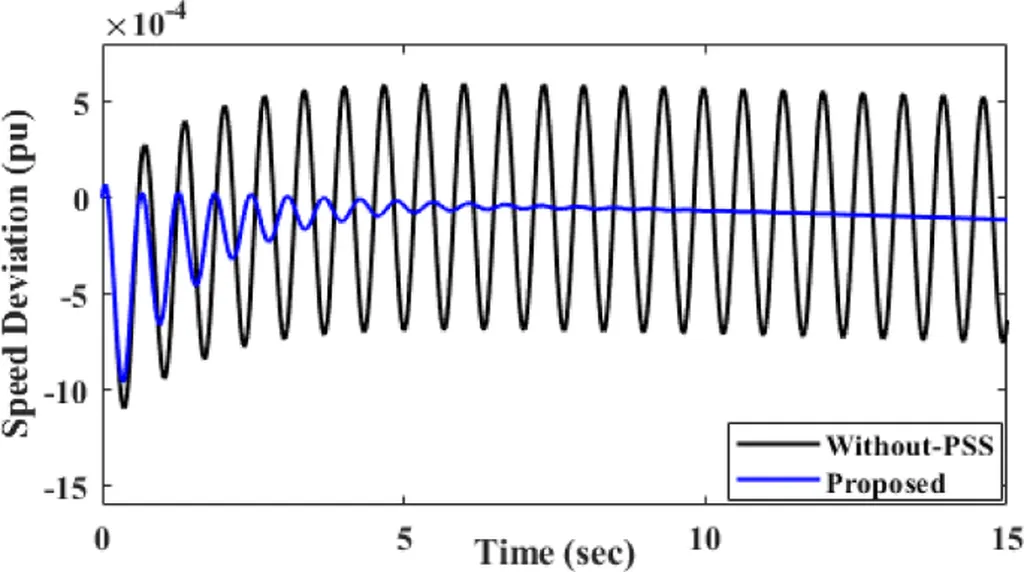
The researchers evaluated the performance of the SDF controller using two- and three-area power system models. They compared the SDF control scheme with a conventional frequency difference-based damping method. The results demonstrated that the SDF controller achieves state-feedback performance, providing superior damping of both inter-area and intra-area oscillations compared to the traditional approach. This enhanced damping capability highlights the potential of the SDF controller as a practical solution for stabilizing power systems that are increasingly reliant on power electronics.
The practical applications of this research are significant for the energy sector. As power systems continue to evolve with higher renewable energy integration and longer transmission lines, effective damping of low-frequency oscillations becomes crucial for maintaining grid stability. The SDF controller offers a robust and adaptable solution that can be integrated with existing HVDC and energy storage systems to improve overall grid performance. By enhancing the damping of critical oscillatory modes, this technology can contribute to more reliable and stable power systems, supporting the transition to a cleaner and more sustainable energy future.
The research was published in the IEEE Transactions on Power Systems, a leading journal in the field of power and energy systems engineering. The findings provide valuable insights for grid operators, engineers, and researchers working to address the challenges of modernizing power systems and ensuring their stability in the face of increasing renewable energy penetration.
This article is based on research available at arXiv.